Website Development
A conversion-built, blazing-fast website engineered to rank in your coverage area, with a self-serve ordering system that checks a customer's address, confirms availability, and books the install directly into your billing platform.
Most WISP websites are brochures. They list a few plans, a phone number, and a coverage map that is out of date. Meanwhile the customer standing in their kitchen wants one thing: to know if they can get service at their address, and to order it right now.
We build the website that answers that question and closes the sale.
Built to rank in your coverage area
Google decides who a rural customer sees first, and it rewards sites that are fast, technically clean, and clearly local. We build every ISP Hyperdrive site with:
- Coverage-area landing pages for every town and service area you cover, so each one ranks on its own.
- Schema markup and technical SEO that tells search engines exactly what you offer and where.
- Core Web Vitals performance tuned so pages load instantly, on the same rural connections your customers use.
Modern architecture, not a WordPress liability
Most old-school marketing companies are still pimping WordPress, Drupal, and other dated CMS platforms. They are slow, they are a nightmare to keep updated, and they are the number-one thing that gets a small business hacked. Every plugin is a new door left unlocked.
We do not build that way. Every ISP Hyperdrive site is statically generated on Hugo or Astro, two rock-solid modern platforms, and shipped in a dockerized container. Every page is pre-rendered to plain HTML before a visitor ever arrives, which means:
- Hacking is basically impossible. There is no live database or admin login sitting on the page for an attacker to break into.
- Speed is ridiculous. Every page is already built, so it loads instantly, even on a rural connection.
- The AI crawlers never choke. The bots that decide whether to cite you in AI search results get clean, instant HTML on every request, so nothing stops them from indexing you.
Self-serve ordering that books the install
This is what sets your site apart. Instead of a contact form that lands in an inbox, your site runs a real ordering flow, wired directly into your billing and provisioning platform.
A customer enters their address. Our system checks serviceability and technician availability for that exact location. If you can serve them, it shows real install windows and lets them book their own install, the same way they would reserve a meeting on a Calendly link. The order lands in your system with no double entry and no phone tag.
We have already built integrations for VISP, Splynx, and UCRM, with more on the way. You keep the billing platform you already run. We connect to it.
AI address validation that actually finds the customer
Serviceability only works if the customer can find their address, and rural addressing is messy. Our custom address-validation tool pulls in the address lists that define your footprint, from the Google Maps API, e911, BEAD, and Regulatory Solutions, straight from your coverage map. It then uses AI to help a customer match what they typed to a real serviceable address on your network, fast, even when the formatting is imperfect.
Privacy is built in. Each ISP’s address database is kept fully separated, and you can bring your own OpenRouter AI key so your lookups run on your account and never mix with another operator’s data.
The result is a website that works like your best salesperson: it qualifies the lead, confirms you can serve them, and books the truck roll, day or night.
Compliant by design, not by patch
A website is a legal surface, and most WISP sites are quietly exposed. We build compliance in from the start instead of bolting it on later:
- ADA accessibility. Semantic markup, keyboard navigation, color contrast, and screen-reader support, so the drive-by accessibility lawsuits that target small businesses have nothing to land on.
- GDPR. Clear consent, honest cookie handling, and data practices that hold up if you serve or market to anyone in the EU.
- California DPA. Privacy disclosures and data-handling built to satisfy California’s consumer privacy rules.
You get a site that protects you, so a fine or a demand letter never arrives because of a checkbox nobody remembered to tick.
Broadband Labels that generate themselves
The FCC requires you to display Broadband Consumer Labels for every plan, and keeping them accurate by hand is a chore that is easy to get wrong. We make it automatic.
Your plans live in a rich, structured data model, not buried in page text. From that single source of truth we auto-generate your Broadband Labels and publish them across your site. When a plan changes, you update the data once and the labels, plan pages, and ordering flow all update themselves. Your site stays compliant without anyone rebuilding a label by hand.
That same structured data is exactly what AI systems can read and understand, so the work that keeps you compliant also makes your plans legible to the search engines and assistants deciding who to recommend.
Winning the AI search war
Here is the uncomfortable part. When a rural customer asks ChatGPT or Google’s AI for the best internet provider at their address, the answer is often AT&T, Spectrum, or a generic 5G service, because the cable and fiber companies have spent years building the backlinks and authority that AI models learn from and cite. WISPs are barely in the conversation.
We are working to change that at the industry level, pushing for a coordinated backlink-building effort so operators stop leaking authority to their competitors and start passing it to each other, the same way the cable associations already do. Our CEO made the full case in an open letter to WISPA.
On your site specifically, we build the schema, the authority signals, and the backlink profile that get you cited by generative search, so when the AI names a provider, it names you.
Domain authority you own, not rent
Ads stop working the moment you stop paying. Domain authority does not. The goal is organic traffic that keeps flowing whether or not you are running a campaign this month, and that comes down to backlinks: other credible sites pointing at yours.
We build that authority deliberately. We earn links to your main domain, and where it helps, we stand up and grow supporting side-domains, local resource sites, coverage guides, and community content, that build their own authority and pass it back to you. Over time your domain gets stronger, your rankings climb on their own, and you stop being fully dependent on long-term ad spend to be found.
Think of it as building an asset instead of renting attention.
What you get out of it.
Get found first
Local SEO and coverage-area pages put you ahead of the competition when someone searches for internet at their address.
Book installs while you sleep
Customers pick a real install window and reserve it themselves, the same way they book a demo on a Calendly link.
Turn address checks into orders
A serviceability check confirms coverage at a specific address, then moves the customer straight into booking instead of a contact form.
Unhackable and instant
Statically generated and dockerized on Hugo or Astro. Every page is pre-built, so there is nothing to hack and nothing to slow it down.
Pages Google rewards
Fast, clean, technically sound pages that score well on Core Web Vitals and hold their rankings.
Own your coverage map
Dedicated landing pages for every town and service area you cover, each one its own front door from search.
Fewer support calls
Self-serve ordering and clear plan pages answer the common questions before the phone ever rings.
Broadband Labels, handled
Your plans are stored as rich structured data, so FCC Broadband Labels are generated automatically and stay in sync every time a plan changes.
Compliant by design
Built to meet ADA accessibility, GDPR, and the California DPA from the start, so a lawsuit or a fine never comes from your website.
Cited by AI
We build the backlinks and authority that get you recommended by AI search, where fiber and cable already have a head start.
A few WISP sites we're proud of
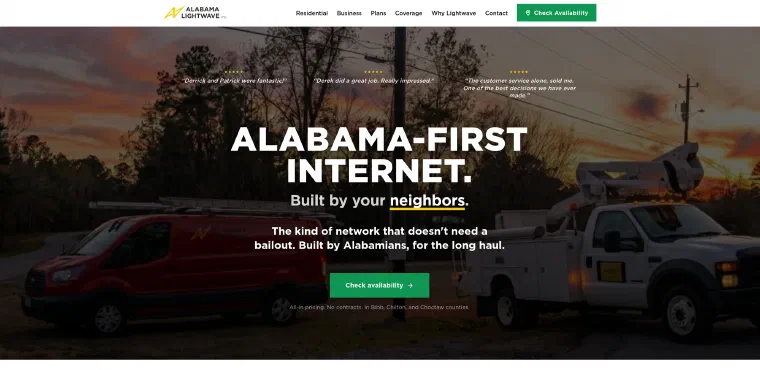
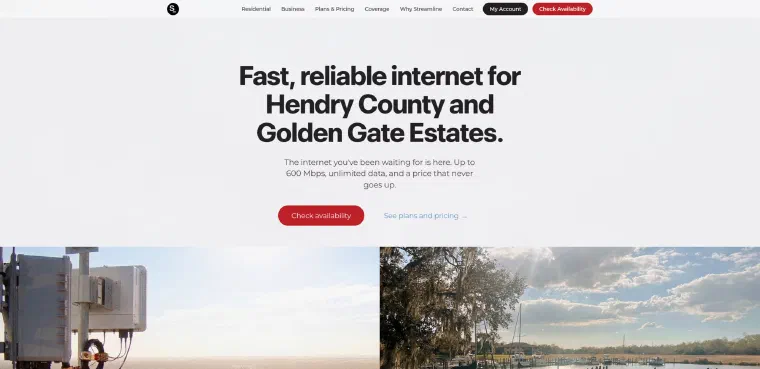
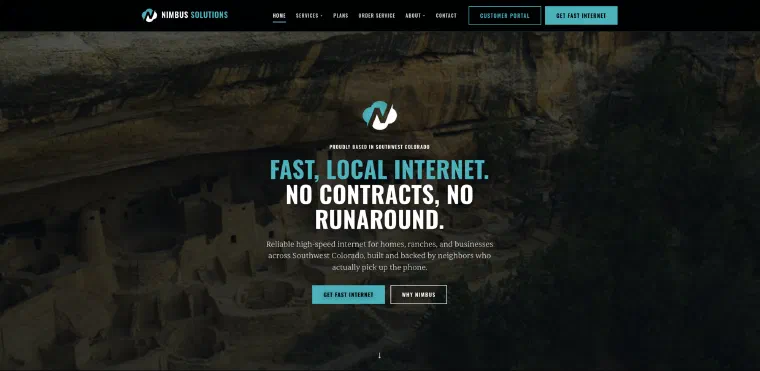
This is not a template we are trying out on you. Here are a few of the live, in-production WISP sites we have designed and built, with more shipping all the time. See the full roster, county guides included, on our Sites Under Management page.
Frequently asked.
How does the online ordering system work?
A visitor enters their address, our system checks serviceability and technician availability for that location, and if you can serve them, it lets them pick an install window and book it on the spot. The order and appointment flow straight into your billing platform, so your team sees it without any double entry.
Which billing and OSS platforms do you integrate with?
We have built integrations for VISP, Splynx, and UCRM, with more on the way. If you run something else, tell us and we will scope it.
Do I have to change my billing system?
No. The ordering system connects to the platform you already run. You keep your billing, provisioning, and workflows exactly as they are.
How does the address validation work, and is my data kept private?
We ingest the address lists that define your coverage, from sources like the Google Maps API, e911, BEAD, and Regulatory Solutions, and load them into a custom AI-powered tool that helps customers match what they type to a real serviceable address fast. Every ISP's database is kept fully separated, and you can bring your own OpenRouter AI key so your lookups never mix with another operator's.
Do you build on WordPress?
No. Old-school agencies still push WordPress, Drupal, and similar dated platforms that are slow, hard to maintain, and easy to hack. We build on Hugo or Astro, statically generated and dockerized, so every page is pre-built plain HTML. There is nothing to break into, it loads instantly, and the AI crawlers that decide who to cite never choke on it.
Will a new site hurt my current search rankings?
We migrate carefully, preserve your existing URLs and content equity, set up redirects, and typically improve rankings by fixing the technical and local-SEO gaps most WISP sites have.
Is the website compliant with ADA, GDPR, and privacy laws?
Yes, by design. We build for ADA accessibility, GDPR, and the California DPA from the start: semantic accessible markup, proper consent and cookie handling, and privacy disclosures. That protects you from the accessibility lawsuits and privacy fines that increasingly target small businesses, rather than leaving it as a checkbox to patch later.
Do you handle FCC Broadband Labels?
Yes, automatically. Your plans are stored as rich structured data, and we generate your Broadband Consumer Labels from it and publish them across your site. When a plan changes, you update the data once and every label and plan page updates itself, so you stay compliant with no manual rebuilding. That same structured data also makes your plans easy for AI systems to read and cite.
What are you doing about AI and generative search?
Fiber and cable companies have spent years building the backlinks and authority that AI models now learn from and cite. We are pushing our industry toward a coordinated backlink-building effort so WISPs can compete, and we build that authority into your site directly. Our CEO laid out the strategy in an open letter to WISPA about the AI search war.
How do you build domain authority and backlinks?
We earn links to your main domain and, where it helps, stand up and grow supporting side-domains like local resource sites and coverage guides that build their own authority and pass it back to you. The point is durable organic traffic that keeps flowing without depending on long-term ad spend. Ads stop the moment you stop paying, domain authority does not.
Explore the rest of the stack.
Social Media Management
Big-brand social talent, run for your WISP
Ad Spend Management
Google and Meta ads, audited against run-away spend
Custom Mobile App Development
White-label tower-camera apps, built by proven talent
Local News Partnership
Tower cameras featured on local TV, with partners like Gray Media
Let's grow your WISP.
Book a call and we'll show you exactly how website development fits your market, your plans, and your budget.